Saturday, November 26, 2022

Something old, something borrowed, something blue – is there anything new about Gainsborough’s 'Blue Boy'?

Thomas Gainsborough, The Blue Boy, 1770, Huntington Art Museum San Marino, California

2022 saw The Blue Boy pay a brief visit to the National Gallery in London exactly a hundred years after he was waved a tearful goodbye by record crowds who couldn’t quite believe we were selling this national treasure. I’m not sure his stay this time has raised much excitement.  The Blue Boy is one of those pieces of art which proves the saying ‘familiarity breeds contempt’. He’s entered popular culture through a thousand jigsaws and cheap reproductions, exploited by Tarantino who dressed Django in his costume, taken up by the gay community in the 1970s, re-appropriated by Kehinde Wiley.  The National Gallery attempted a reassessment, giving context by showing The Blue Boy alongside examples of Gainsborough’s work, and juxtaposing him with Van Dycks which inspired his costume, but in both cases reviewers suggested that The Blue Boy fell short. So, why is he so famous?

The Blue Boy was painted by Gainsborough in 1770 at a time when he was trying to break out of the security of provincial portraiture and make a name for himself as representor of the fashionable elite. He had already moved from Suffolk to Bath in 1759, where he had built a reputation producing three-quarter length portraits in which sumptuously rendered fabrics were shown off against plain backgrounds; and in 1768 he had become a founder member of the Royal Academy, exhibiting at its inaugural show.  So the 1770 Portrait of a Young Gentleman (as it was originally called) was designed to make a splash. Its essentially a fancy picture, painted to show his style and ability, the subject chosen as representative but non-specific and deliberately designed to appeal. Originally, the crowd-pleasing elements included a small dog walking beside the boy. The choice of costume, historical rather than contemporary, is part of this 'fancy',  but it also allows Gainsborough to make an implicit comparison with Van Dyck, and show that he was highly adept at creating the fashionable silks and lace. Van Dyck was enjoying a revival in popularity, and this is one of a number of Gainsborough pictures which uses Stuart costume (including the same suit), just as he was one of a number of contemporary artists to employ the device. Everyone from George III down seemingly wanted to dress up as a cavalier.

The Blue Boy was also a transitional painting stylistically. Gainsborough had begun painting portraits in Suffolk in a style influenced by Arthur Devis - with doll-like figures who never seem entirely comfortable in their clothes, yet still manage to effectively convey both the sitter's physical attributes and character. His particular skill was to set these figures within a naturalistic landscape - his real artistic love.  Thus, most famously, we see Mr and Mrs Robert Andrews (1750), surveying their estate from a garden seat, her bedecked in her finery, and him in the casual dress of a country gentleman who's just been out shooting. After his move to Bath, however, Gainsborough's style started an evolution which saw him both embracing the scale and dynamic posing of the 'grand manner' portraiture popularised by Joshua Reynolds, and incorporating new French trends in colour and fluid brushwork.  Thus, the life-size proportions of The Blue Boy, emphasised by the low horizon which increases his height, and his dynamic pose, one foot in front of the other, as well as the self-assured entitlement of the figure is reminiscent of works like Reynolds' Captain Augustus Keppel (1752-3).  Yet the colour which gives The Blue Boy his nickname was certainly disapproved of by Reynolds who firmly believed that warm tones should predominate. 

The Blue Boy did its job well. From the start it was well received, quickly given the name which stuck. Like any good fancy picture it suggests an imagined narrative, or invites the viewer to concoct one of their own. The boy of the cusp of manhood, whose swagger looks just a little awkward, standing in front of the lowering sky which seems to portend storms ahead. Seen as a historical image, the Civil War looms on the horizon; seen as a contemporary costume piece, we have a psychodrama about adolescence; looking back it foreshadows the traumas of the late 18th century still to come. But the real star of the painting is not the boy at all, nor proto-Romantic background, it's his suit: a gloriously rendered sheen of the sort of blue that you rarely see in art. That's what makes The Blue Boy worth looking at again. And again.


Penelope Boothby

Thomas Banks Monument to Penelope Boothby, marble, 1793, St Oswald's Church,
 Ashbourne, Derbyshire

In St Oswald's Church in Ashbourne you can find Thomas Banks' 1793 monument to Penelope Boothby, who died just before her sixth birthday. It sits in the family's memorial chapel alongside more conventional monuments from the 14th, 15th and 16th centuries, showing husbands and wives lying on their backs, eyes open, hands clasped in prayer. The contrast with Banks' creation is striking, bringing increased emotional depth to an already beautiful piece of sculpture. There is the white purity of the carrara marble which is sparkingly luminous in the dark interior of the church, against the warm burnish of the older figures' alabaster. There is the scale: the life-size child seems so tiny and fragile amongst the solid, adult figures which fill the rest of the chapel. In both cases the jolt is like seeing the small, white coffin of a child's funeral. But Banks' really striking innovation is to place Penelope on her side, naturalistically posed as if she were sleeping. You approach her from behind, it feels like an intrusion, and walk round the tiny bare feet to see the relaxed slumber of the closed eyes and slightly parted lips as her head rests easily on a pillow. Her hands are not quite clasped in prayer. Her skirts spread out in rippling folds which suggest life perhaps ebbing away. There is perhaps to great an emphasis on the body beneath, a hint of sexualisation in the bared shoulder where her gown has slipped, but ultimately Banks' has presented a wonderfully beautiful image of a child, frozen in eternal sleep. The preparatory model for the monument is in the John Soane Museum in London. It allegedly reduced members of the royal family to tears when it was exhibited at Somerset House and you can believe it. The dark patina of the plaster enhances the girl's features making the face all the more affecting.

Thomas Banks, Monument to Penelope Boothby, plaster, 1793, John Soane Museum

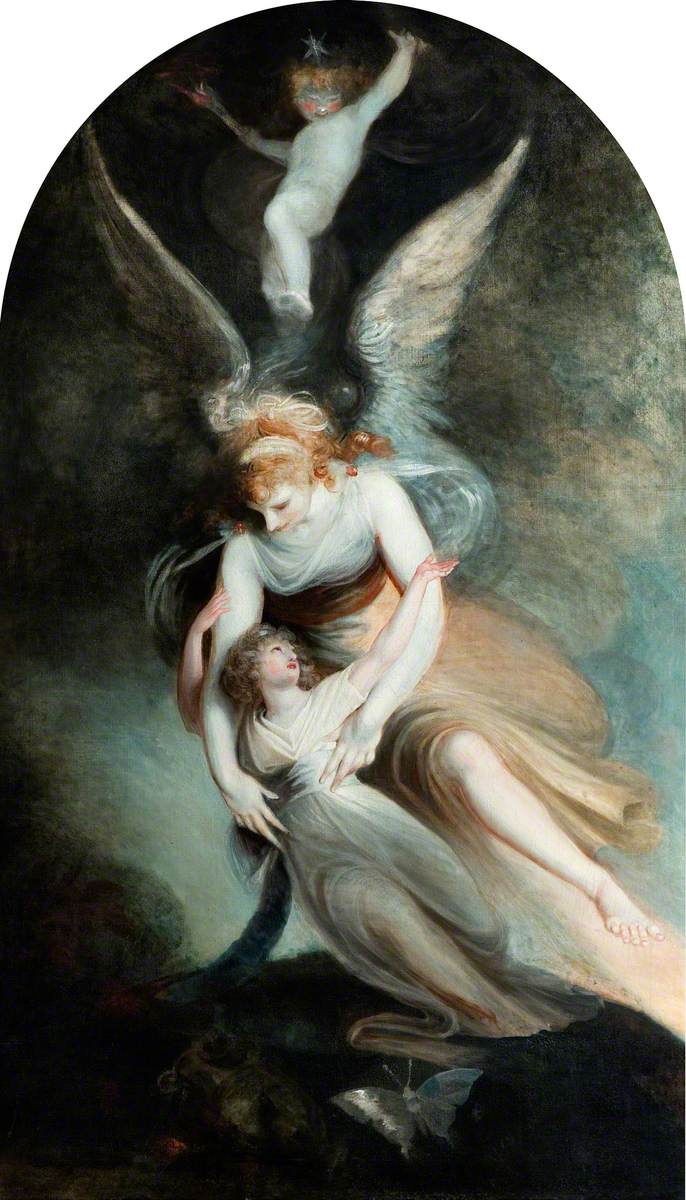
What is even more remarkable, however, is that Banks' was not the only memorial which Penelope Boothby's father commissioned. In 1792 he asked family friend Henry Fuseli to paint her. The Apotheosis of Penelope Boothby shows her, not as a small child, but as an older girl on the cusp of womanhood. She is being carried up to heaven by an angel, guided by a cherub at the top of the vertical canvas. The earth is represented as a shadowy semi-circle below; a butterfly and a broken vase rather crudely symbolise the fragility of mortal life. The ghostly near monochrome palette and the dynamic diagonals of the composition can be seen as typical of Fuseli but for an artist who often dwelt on the macabre or the outlandishly shocking, there is a softness too. The diaphanous skirts create a sense that Penelope is already losing her corporeal form, yet she is looking and reaching upwards with pink cheeks and reddened lips, almost as of she is finding her heavenly (after)life. The angel, whose wings fade into the misty sky behind, looks down with maternal solicitude, her arms reaching round to, help her daughter on her last journey.

Henry Fuseli The Apotheosis of Penelope Boothby, 1792-4, Wolverhampton Art Gallery

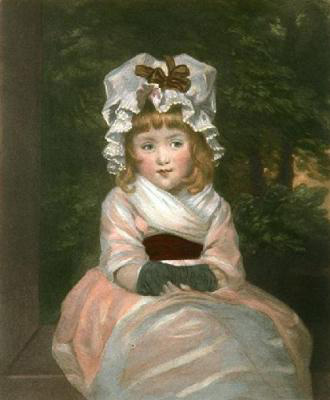
Despite dying before her sixth birthday, Penelope Boothby was also painted by Joshua Reynolds: his 1788 portrait of her wearing an oversized mob cap was an instant success, and continued to be recognised as a painting iconic enough for John Everett Millais to reference it in his 1879 painting Cherry Ripe. Reynolds represents Penelope as an idealised image of girlhood, luminous in white purity against a dark, almost threatening woodland landscape. Her covered clasped hands, the crossed shawl on her bodice, the cocoon of her skirts and the oppressive fussiness of her cap restrict and  internalise her. But her unruly curls dangle freely and her eyes look off the side as if her thoughts are doing the same. 


Joshua Reynolds, Penelope Boothby, 1788

Penelope's parents never recovered from the loss of their daughter. They lived separate lives afterwards: her mother returned to her parents' home and her maiden name. Her father, Brooke Boothby, sought multiple ways to memorialise his daughter, including publishing a book of poetry Sorrows Sacred to the Memory of Penelope. Always extravagant in terms of money and emotion, he continued to live to excess, eventually losing the family home, Ashbourne Hall, and dying in poverty in France. Boothby had always been a friend and patron of artists: he referred to Fuseli as 'the great wizard' and in 1783 organised an extravagant outdoor party for the artist which included masques, poetry-readings and medieval costumes. He supported Joseph Wright of Derby, commissioning at least one portrait from him, purchasing landscapes and supporting the artist's first London exhibition. Wright's painting of Sir Brooke shows him as a creature of nature, reclining in woodland with a copy of Rousseau. Sir Brooke had met Rousseau in the 1760s when the philosopher was living in temporary exile in Britain, and had later visited him in Paris. He also published the first French text of Rousseau's Confessions in England. 

Joseph Wright of Derby, Sir Brooke Boothby, 1781, Tate

The similarity of pose between the father's portrait and Banks' memorial to his daughter is often remarked on, but the link seems tenuous. The posed informality of Boothby from the figure against his cheek to the unbuttoned waistcoat is a world away from the restful sleep of the tomb. 


Thursday, November 17, 2022

Rebecca Solomon - A 'Young Teacher' and Much More


Rebecca Solomon, A Young Teacher, 1861

Rebecca Solomon (1832-1886) hit the news in 2022. Her painting A Young Teacher was bought by Princeton University Art Museum, for over ten times its auction estimate. Subsequently an export bar has been placed on it 'on the grounds that its departure from the UK would be a misfortune because it was of outstanding significance for the study of women artists and Jewish art in 19th century Britain, as well as to the history of art and Empire.' Tate and the Museum of the Home clubbed together to raise the necessary funds and A Young Teacher has been on display ever since. The painting is now by far the best known of Solomon's small group of surviving works but in fact, it was not one of her more successful. It didn't sell when it was exhibited in 1861 and critics appeared unsure of the subject, confusing Jamaican-born model Fanny Eaton with an Indian ayah. It was not Solomon's major work of that year, when she chose to exhibit The Arrest of a Deserter at the Royal Academy and showed A Young Teacher at the less prestigious Henry Wallis' French Gallery.  Nor is it even particularly representative of Solomon's work, employing a more Pre-Raphaelite emphasis on texture, pattern and drapery than many of her paintings. 

Therein lies the problem with most discussion of Rebecca Solomon's work. She was a Jewish woman who managed to make a living as an artist in mid-Victorian London. But somehow those facts have been subsumed into two alternative narratives, one which revolves around her relationships with her brothers, and one which fixes her work within a Pre-Raphaelite context. Rebecca was one of eight children in the Solomon family, three of whom became successful artists. Her older brother, Abraham and her younger sibling, Simeon, both studied at the Royal Academy, although Rebecca herself was excluded and had to attend the much less prestigious Spitalfields School of Design. This clearly rankled and she was one of a group of women who campaigned to change Academy policy, resulting in the first female students being admitted in 1860. 

As a single woman, Solomon made what was at the time the obvious decision to live and share studio space with her brothers, first Abraham until his early death in 1862 and then Simeon. And, as is the case with much literature on women artists, this has led to the implication that without those family connections she would have never had a career. That she is somehow diminished as an artist because she pursued the same career as other members of her family. Nothing could be further from the truth. Solomon earned her own living as drapery specialist John Everett Millais' studio. She had a wide circle of her own friends and correspondents, including Dante Gabriel Rossetti and George du Maurier. She was very active in promoting her own work. The likelihood is that she introduced Simeon to Pre-Raphaelitism rather than the other way round. The final and tragic irony is that far from helping her career, her brother effectively destroyed it. Her close association with Simeon meant that when he was prosecuted for indecency in 1873 Rebecca was somehow implicated in his 'debauchery'. Her career never recovered, she didn't exhibit after 1874, and we know very little about her life. The fact that her death, the result of a traffic accident, was linked to unsubstantiated rumours of alcoholism and substance abuse, shows just how detrimental to her reputation Simeon's arrest was.  Perhaps most unjustly of all, he did continue to paint. 

Rebecca Solomon's close association with Simeon, and her use of Fanny Eaton as a model both in A Young Teacher and in A Double Tie leads to the second problem with scholarship about her. She has been repeatedly described as a Pre-Raphaelite: she was included in Jan Marsh and Pamela Gerrish Nunn's 1999 Pre-Raphaelite Women Artists and the National Portrait Gallery's 2019 exhibition, Pre-Raphaelite Sisters. Most of the press coverage surrounding A Young Teacher refers to her as a Pre-Raphaelite, and whilst association with the movement has undoubtedly raised her profile today, it is also reductionist. The reality was that Solomon was canny market operator. She was well aware of the popularity of her older brother Abraham's narrative genre style, and judging by the range of her subjects she was always willing to produce what she thought the public wanted. 

Thus we see Rebecca Solomon producing paintings based on history (The Fugitive Royalists or The Claim for Shelter (1862)), literature (Imogen from 'Cymbeline' (1865)) and contemporary talking points (The Story of Balaclava Wherein he Told of the Most Disastrous Chances (1855). We see her, clearly inspired by the success of her older brother's 'paired' genre scenes like Waiting for the Verdict (1857) and Not Guilty (The Acquittal) (1857,) produce a similar pairing: The Virtuous Undergraduate (1859) and The Dissolute Undergraduate (1859). We see her influenced by Pre-Raphaelite aestheticism with work like Primavera (1864), where narrative subject matter is replaced by a painting of mood and beauty. Whereas this variety is often portrayed as a lack of individuality, or, even worse, as a feminine lack of dedication and steadfast character, the reality is that it shows an artist attuned to market trends and willing to adapt to make commercially successful paintings.

Rebecca Solomon The Governess, 1854

Rebecca Solomon had a recognisable and very individual interest in representing those on the margins of society, and particularly to subtly underlining the experience of contemporary women. Most famously, her depiction of The Governess (1854), goes a stage further than Richard Redgrave's 1844 version in deliberately juxtaposing the dowdily dressed teacher with the pretty-in-pink young mother enjoying her piano playing and attentive husband, whilst her child is looked after by someone else. The governess, purely because of her social and financial status has lost the opportunity to have a husband or a child of her own. But through the close proximity of the protagonists, Solomon also suggests the careless disregard of the employers, and the invisibility of the woman in whom they are entrusting their son and heir. 

Richard Redgrave, The Governess, 1844, Victoria and Albert Museum, London

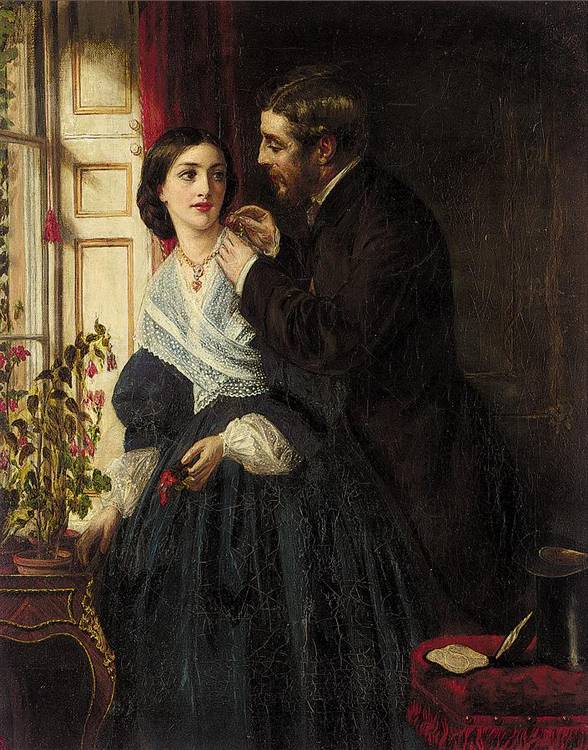
Perhaps more subtly, in all her depictions of relations between the sexes, Solomon underlines the restrictive expectations placed on contemporary woman. In The Birthday Gift, the looming intrusiveness of the man belies the title, suggesting that the 'gift' comes at a potentially unacceptable price. The repeated use of red, the heaviness of the necklace and the juxtaposition between interior darkness and light, reinforce the positioning of the figures. 

Rebecca Solomon The Birthday Gift, undated
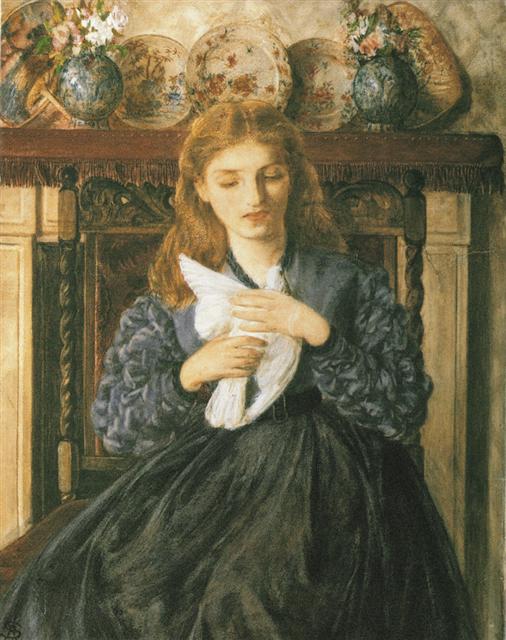
None of these paintings could reasonably be called Pre-Raphaelite in style, but even in those works where Solomon is obviously experimenting with the ideas of the movement, her personal interests remain. The modern appeal of A Young Teacher lies in its overt exploration of class, race and gender. In The Wounded Dove, Solomon, more subtly, exposes the confined middle class existence of the female figure, destined to be as ornamental as the mantlepiece decorations and as trapped as the bird she holds. The shallow picture space and formal frontal pose reinforces that sense of confinement and display; the fussy bulbous gathering of material on the sleeves of the dress hides the girl's 'natural' form and seems to deliberately resonate with the similarly coloured rounded vases behind. The female figure therefore becomes not just a wounded dove but a flower, plucked and destined to fade. The centrally positioned plate acts as a kind of faux halo: this is a world which worships a constructed image of womanhood.

Rebecca Solomon The Wounded Dove, 1866 (watercolour), Aberystwyth University

Rebecca Solomon was a successful mid Victorian painter. She was also Jewish and a woman and that gave her a unique perspective which filtered, probably subconsciously, into her work. She deserves to be better known, not as the sister of Simeon, nor as a fringe member of the Pre-Raphaelite movement, but as an individual artist in her won right.

Wednesday, November 2, 2022

When is a Vermeer not a Vermeer?

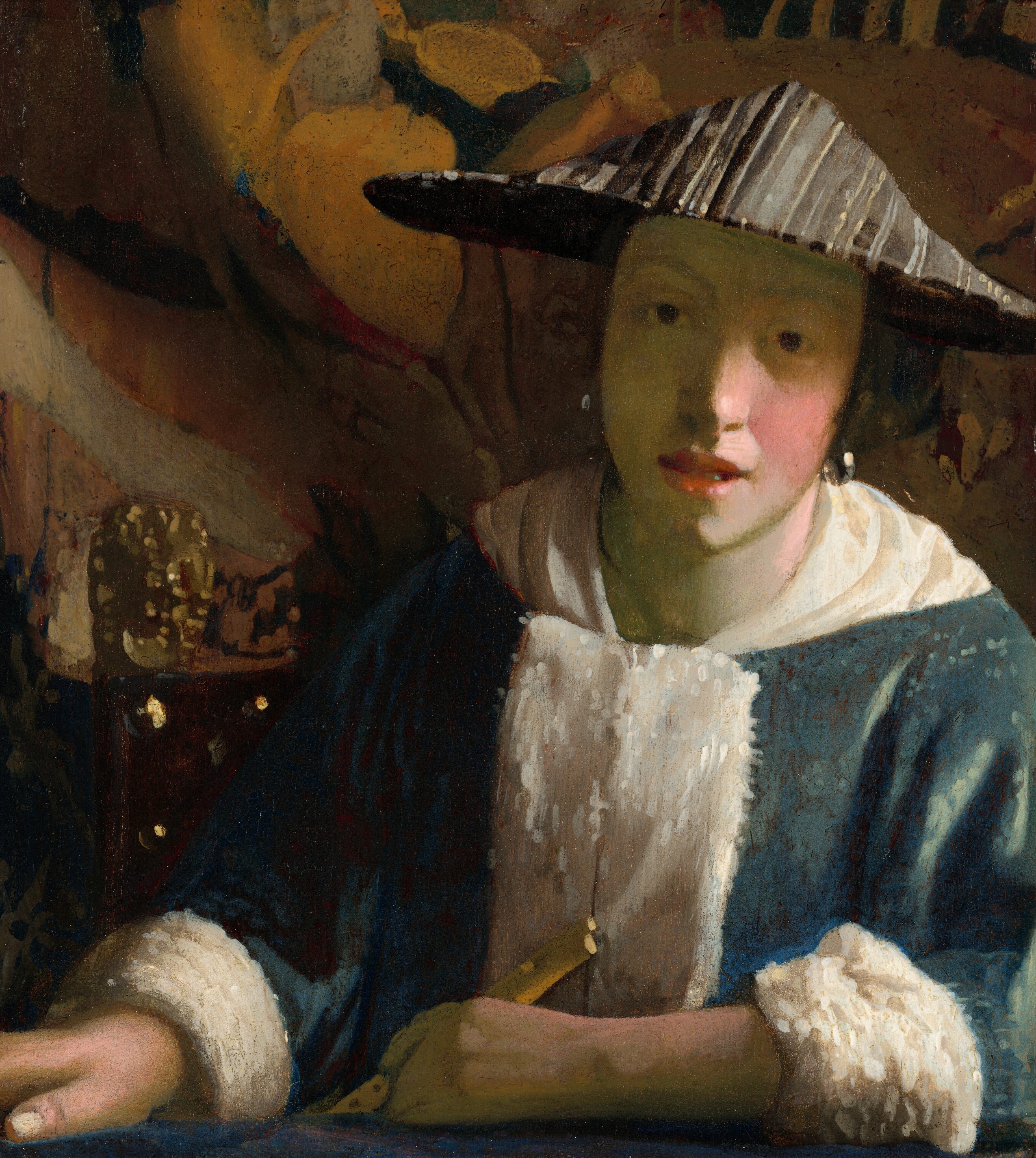
Johannes Vermeer Girl with a Flute 1669-75, National Gallery of Art Washington

The National Gallery of Art in Washington reported in 2022 that one of its Vermeers was being downgraded to a studio work, possibly even a forgery. After extensive scientific analysis on the six 'Vermeers' in their collection the museum re-established the authenticity of three, and confirmed as forgeries two works which had long been recognised as such, as well as re-attributing Girl with a Flute. The painting had been in their collection since it was donated as a genuine Vermeer in 1942, although its authenticity has always been disputed by scholars. According to the gallery, their new analysis has shown that, whilst the painter was clearly familiar with Vermeer's techniques, they 'lack the skill or experience to reproduce them'.

Vermeer is unusual as an artist, in that very few of his works are known - 35 in total - and it is generally thought that he worked slowly, and alone, producing relatively few paintings over the course of his career. The suggestion that this is in fact a studio work offers a new perspective that, for at least some of his career in Delft, Vermeer did employ assistants. The gallery has speculated that these may actually have been family members, perhaps his daughter Maria, who would have been in her late teens when the work was supposedly painted (c.1669-75), but this seems rather tenuous. 

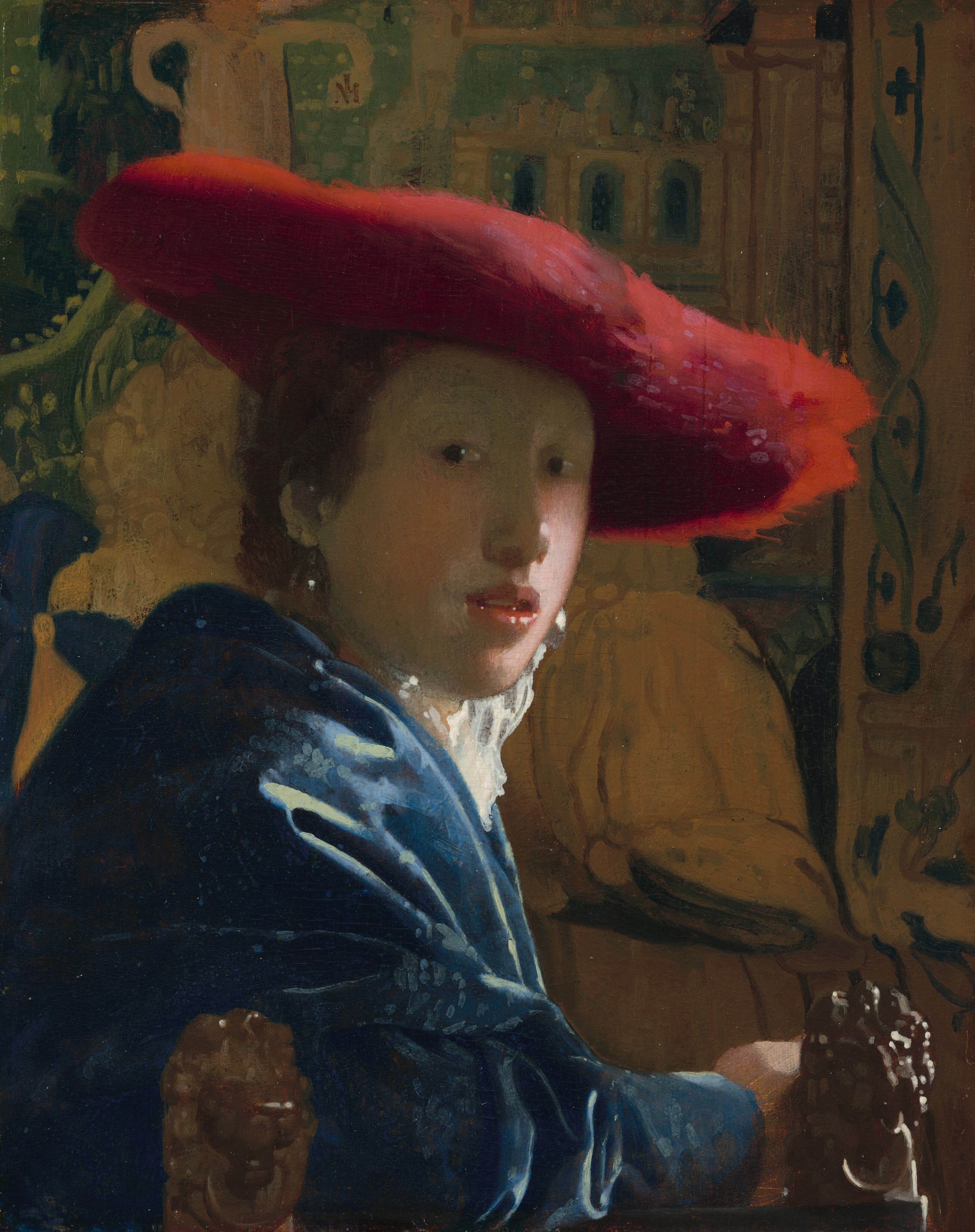
            Johannes Vermeer, Girl with the Red Hat c.1669, National Gallery of Art Washington

The painting is similar in style to Girl with the Red Hat, which uses the same model, and a similar close-up composition in which the figure looks out of the canvas with an open-mouthed, ambiguous expression. Both paintings are very loosely painted, with Vermeer's characteristic white highlights visible blobs on the surface and paint application clearly evident throughout the varied colouration and texture of the costumes. Both exploit strong directional lighting from an unseen left-hand source. Both images juxtapose large primary colour blocks, off-set by areas of white, and emphasise the shallow picture space with a fussy background of tapestry or draperies. It is this which sets them apart from the simplicity of Girl with a Pearl Earring (1665), a work which nonetheless has other obvious similarities. All three fall into the category of tronie - figurative works which show off the artist's skill - rather than being specific examples of portraiture. 
Girl with a Flute sits comfortably within Vermeer's work on a number of levels. Images of musicians are common; the fur-edged blue dress is similar to that in Woman Holding a Balance (1662-5); she wears tear-drop pearl earrings; the lion's head decorated chair features in a number of paintings.

The National Gallery of Art's Vermeer's Secrets exhibition (October 2022-January 2023) explored their analysis of the artist's works, and the new information about Girl with a Flute effectively formed a publicity release for the show. The information was widely reported. Vermeer is always big news, and the art world was currently gearing up for the Rijksmuseum's 'biggest ever' blockbuster of the artist's work in 2023 which would bring together 28 out of the 35 extant works. The media loves a fake, which panders to popular enthusiasm for debunking experts; the museum is able to boast of its new, more scientifically advanced analytical abilities which have finally proved the 'truth'; everyone will go to the exhibition determined to see whether they can tell it's not genuine. Meanwhile a few hundred thousand dollars will have been knocked off Girl with a Flute's valuation.

But the painting is still the same painting. Isn't it time art moved on from an obsession with 'the artist' and focussed more on the object itself? This Vermeer debate has coincided with news that one of the many versions of Titian's Venus and Adonis was going to be auctioned, and described as being by the artist himself, despite having previously been considered a studio copy. There are dozens of contemporary versions of the painting which Titian initially produced for Philip II of Spain: art was a business, this was a popular subject and it doesn't seem much of an exaggeration to say they were churned out. Their interest, surely, lies in how they varied, who they were produced for and why, why it was such a popular subject etc, rather than whether Titian himself applied any of the paint. Yet so much time, effort and ink is still wasted on proving or disproving a unique hand in works which were inevitably produced in a studio environment, and on a subject which can never be definitively proved one way or another. The painting is still the same painting. Girl with a Flute remains a mysterious, intriguing representation of a young woman who engages ambivalently with the viewer; she's wearing an odd, almost Oriental-looking hat; the background has an abstracted quality....These are the interesting things with or without the name Johannes Vermeer on the caption.

Monday, October 31, 2022

Kilpeck and Kempley - small churches that pack a big punch

South Entrance 

I'm not a churchgoer in either the religious or the Philip Larkin sense of the term, but some churches are worth a visit. St Mary and St David in Kilpeck in Herefordshire is a tiny church in a tiny village which will take your breath away. Its Romanesque carvings by masons of the  Herefordshire School date from around 1140 but appear almost surreally pristine in the sharpness of their definition. They are characterful, clever, witty and deeply symbolic, combining realism, fantasy and abstraction in a beguiling and thoroughly modern mix. The tiny triple-arched doorway is supported by double columned jambs carved from single pieces of sandstone. The left side has two helmeted warrior figures turned towards the entrance with weapons raised, almost as if they are guarding the doorway. Above the tympanum which represents a tree of life, there are arches of fantastical figures and beakheads with an angel flying, wings outstretched in the centre. Some 86 corbels mark out the the roofline, each individual, distinctive;  some quirky, some cute, some downright obscene. The famous sheela-na-gig squats
 laughing at our outrage, ambiguous enough to have been spared Victorian bowdlerism and still a mystery today. A hare and hound cuddly enough to be straight out of a children's story sits alongside man-eating animals, elegantly craved birds and fish and characterful human faces. 

Inside the space is small, sparse, slightly musty despite being well-tended, with plain white-washed walls and a simple three part structure - nave, chancel and apse. The chancel arch is supported by three tiers of figures, unidentified saints or evangelists, possibly including a St Peter holding keys. There are suggestions that they may have been influenced by similarly groups figures on the cathedral at Santiago de Compostela, in itself an incredible idea for a tiny church that feels remote today. But it doesn't really matter: the figures' power is in their characterisation and observation, creating each as individuals and giving them a sense of life despite the blank eye sockets. The absolute highlight in this box of treasures are the 'river' vaults  in the apse. They appear to flow form four mouths in the centre of roof, perhaps the four rivers of Eden, their rippling structure defying the solidity of their architectural purpose and perfectly melding naturalism with abstract design.

Detail of  Apostles, St Mary's Church, Kempley Gloucestershire

About 20 miles east lies another remote rural church, St Mary's at Kempley. A plain, and oddly pink-painted on one wall, exterior belies an interior of ghostly faint Romanesque frescoes, long hidden beneath white-wash and now revealed as an echo of what must have been a glorious sight. The church and the earliest frescoes in the chancel date from about 1130 and depict the Apocalypse. On the ceiling, Christ sits in majesty on a rainbow surrounded by angels and the symbols of the evangelists, his hand raised in a blessing that is intended both for the apostles who line the walls, their heads tilted towards him, their hands raised in surprised wonder, and the priests who stood below to administer the Mass. Above the chancel windows, their deep bays exaggerated by foreshortened chequering, sit representations of Jerusalem as the heavenly city. 

The complexity and completeness of this decorative scheme would have been only just visible to the general congregation, but there are fragments of later murals in the nave. High on the wall above the chancel arch and now barely visible, is scene of the three Marys at the tomb; but this is actually the scene reenacted by priests, bringing the Bible to life for their illiterate audience. Elsewhere the murder of Becket, St Michael weighing souls and St Christopher are all visible. Most intriguingly, there is a Wheel of Life, dating from the 15th century: indistinct now, it would have once shown the 10 ages of man from cradle to grave, surrounding a central figure of Christ. The random positioning of these remaining designs, and their spread throughout the nave, suggests that once, on the eve of the Reformation, the whole small church would have been exuberantly decorated.

It is easy to forget, that what we now see as art or history, or as something with spiritual significance, was in the late Medieval period, a piece of total education, designed to bring knowledge, fear, hope and obedience to a population for whom churchgoing was a basic reality of life. What are now quiet rural backwaters, with a musty smell of disuse were active and alive - funerals and christenings, sermons, music, confession, candles. What now remains is a fractional glimpse of that reality. The Kilpeck sculptures would have been painted, their blank eyes drawn in, their costumes coloured - it would have been gaudy, perhaps more like a Hindu temple than a Christian church to modern sensibilities, certainly more like a Spanish Catholic shrine. The Kempley paintings would have been bright and all but overpowering, like a glorious frescoed chapel in an Italian duomo. And what we also forget, is that these churches are a rarity because of the rampant iconoclasm which the Reformation unleashed in England, leaving a terrible legacy of destruction and loss which is somehow swept under the carpet of history. Search out these small treasures and rejoice in the anonymous craftsmen who made them and the society which took pleasure and comfort from such creative beauty.

Friday, October 28, 2022

Donatello's 'Judith and Holofernes'


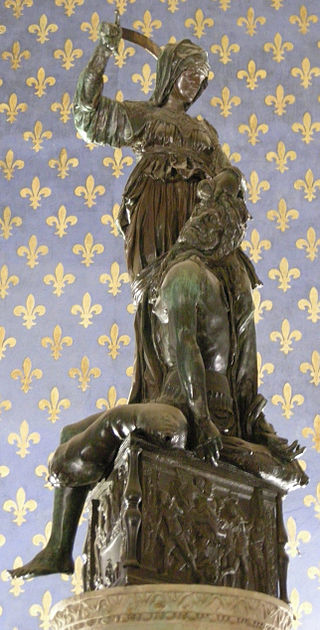
Donatello, Judith and Holofernes, c1455. Palazzo Vecchio Florence

If you ignore the crowds around the replica of Michelangelo's David in the Piazza della Signoria in Florence, there is an abundance of other great sculpture, but the one that doesn't catch your eye is perhaps the greatest of all. Donatello's Judith and Holofernes (in replica) looks small, insignificant, almost unappealing, sandwiched as it is between the two colossi of David and Ammannti's Neptune fountain. It's bronze surface appears dingy and weathered in comparison with their gleaming whiteness; the patina makes it difficult to focus on the subject matter, and the complex composition with its restless surface would surely be better seen on a level, rather than positioned high up on a plinth. The work itself has an introspection, a centripetal dynamic, which is no match for the 'look at me' nudes on either side. Take time to head into the Palazzo Vecchio and look at the original. Take time to imagine how it would have once looked, gilded, standing in the Medici garden alongside Donatello's own version of David.

There is a quiet radicalism about this sculpture which is easily ignored by a 21st century viewer. The base is a cushion, on which Holofernes sits, his weight rendered visible in the sag beneath him. Donatello had used the device before: his St Mark (c.1411-13) stands on a small and obviously rather firm pillow, but the effect there is tentative. Here the yielding softness is palpable and the realism is taken a stage further with the positioning of Holofernes' leg dangling limply over the side of the plinth. It's a deliberate attempt to break the barriers between reality and art, an invasion of the viewers' world, like Mantegna's swags of fruit and architectural framing. Time and again in his reliefs Donatello showed that he was interested in the illusionistic possibilities of perspective to create naturalistic space, playing with the full range of depths which the relief surface allowed, but this is all the more striking for being in 3D. Whereas fifteenth century painters stuck a tentative saint's toe towards the viewer, Donatello shoves a whole limb through the sculptural fourth wall. 

The tight, columnar composition is deceptively simple, and only really appreciable in the round. It manages to combine a strong vertical emphasis, which begins with Holofernes' limp arms, with a downward spiral from the tip of Judith's sword; suggesting both the act of killing and the future death whilst showing neither. The complex drama of the whole narrative is explicit in the entwined bodies, with Holofernes positioned between Judith's legs and her fingers almost delicately entwined in his hair. But Donatello's Judith is neither the bloodthirsty assassin nor the eroticised princess that most artists chose to portray. She is chaste, veiled, swathed in draperies which almost hide her body; take away the sword and she could be Mary cradling a dead Christ. There are plenty of early Renaissance tropes here: an idealised male nude, extravagant detail (the pendant on Holofernes back), Latin inscription and a complex symbolism which has given art historians plenty to hypothesise about. But they remain secondary to the figures and their treatment.

Judith and Holofernes illustrates why Donatello is so good: narrative and character are what matter to him above all else. Every piece by Michelangelo is primarily a triumph of the artist's skill; every Donatello is about making the subject breath. David (c.1440s) as a beautiful young boy trying to grasp the enormity of what he has done; Zuccone (c.1423) and Jeremiah (c.1423) as men prematurely aged by the burden of their prophecy; perhaps most famously The Penitent Magdalene (c.1455) emaciated, haggard, yet eyes burning with belief. Even in the early Santa Croce Crucifixion (c.1409), generally agreed to be by Donatello, and according to Vasari's gossipy version, ridiculed by Brunelleschi as resembling a 'ploughman'; even here you can see an attempt to show a real man in pain. Wood, bronze or marble, relief or statue Donatello pushed the boundaries - technically, emotionally and aesthetically. And he pushed them so far that you have to look forward all the way to Rodin at the end of the 19th century to find another sculptor with the same range and psychological depth.

Friday, October 21, 2022

Beauty and Horror - Howardena Pindell: A New Language at Kettle's Yard (until 30 Oct 2022)

Howardena Pindell's exhibition at Kettle's Yard asks a lot of its visitors. You begin lulled by lyrical beauty: large evocative canvases of floaty coloured dots that reference Seurat and seem to position themselves and their creator safely within the framework of 20th century abstract expressionism. At this stage, you are unaware of the significance of the circle to Pindell - a blunt childhood awakening to the realities of segregation. But even as the story is told and the exhibition unfolds, the beauty remains. Her 'white-washed' collages of circles retain an optimism: in their insistent variety, the colours still visible, poking triumphantly through the surface, their texture suggesting an unstoppable, organically bubbling momentum. Yet you end the exhibition, trapped in a metronomic tick of leaden dread, listening to a faltering yet determined account of atrocity after atrocity. Is the shift just too great?

It seems wrong to criticise Fire/Rope/Water, a piece so powerful, so personal and so long and hard fought-for. It is meant to be uncomfortable and it is. But I sat worrying that I was uncomfortable for the wrong reasons; that here I was, a white woman, watching the same suffering that the white watchers in the images were revelling in. I wasn't sharing their sentiments, but I was still somehow complicit in a horrendous cycle of voyeurism which stopped the mutilated bodies becoming individuals, and preserved them forever as victims. The video, like a lot of Pindell's overtly political art, potentially suffers from overkill. The metronome, the voice, the sound of pauses and pages turned, and the final, seemingly endless roll call of names, is more than powerful enough. The images are too much.

The same can be said of works like Diallo where the circles reappear, now large, spread across the canvas, 41 gaping holes. They are accompanied by images of four guns, two names, key words - none are needed. Those stark wounds, white bone and red flesh through black skin shout loudly enough, or rather they resonate through the silence, like a constellation in the sky, to an ongoing, unspeakable, incomprehensible brutality. Pindell is at her most effective when she is at her quietest. Canvas, ripped and roughly resewn has a textural echoing of poverty and punishment, of homespun and much mended sackcloth, of flayed skin and half healed wounds. Works are pinned to the wall, unframed, objects more than images, rough and irregular, like maps of unknown continents; amoebic, organic, tangible and emotive. Alongside sit small, carefully calligraphed lists and tallies which suggest the commerce and bureaucracy of the slave trade and, like the overpainted chads, an indefatigable desire to restrain and rule. But equally, the hair-thin fragility of the script already fading on the page speaks to the ultimate futility of those systems of control, as the words and numbers dissolve and shift into abstracted pattern. 

Pindell has spent a lifetime fighting, campaigning and overcoming, first within the art world itself, then in a wider political sphere. She can be forgiven for getting angry and being blunt. But what really hits home is the quiet determination. So appreciate it in the range of work, the variety of media, in her resolute refusal to be pigeon-holed. You hear it in the pauses and the page turns, you read it in the spidery scrawl of innumerable numbers, and all those thousands of collected chads. And most of all you feel it in the creativity and the beauty and the hope which she can conjure up. Horror hits hard in the exhibition, but the beauty lingers. 

Zurbaran (National Gallery until August 23 2026): Perfection in a Piece of Cloth

Francisco de Zurbaran, The Martydom of St Serapion , 1628, Wadsworth Atheneum, Hartford Connecticut Francisco de Zurbaran is often describe...