Sunday, April 16, 2023

After Impressionism: Inventing Modern Art (National Gallery until August 13 2023): Over-Familiar Faces

Cezanne, Amboise Vollard, 1899, Musée des Beaux-Arts de la ville de Paris 

There's been a lot of negative publicity about this exhibition, centred around the lack of female artists on show; and that, coupled with the sense of weariness at the prospect of more the same old Post-Impressionist names left me pretty unexcited. In fact, it starts very well. The first few rooms are a tightly curated run-through of French art trends from the 1880s to the turn of the century. The big names are there, justified both by the quality of the works chosen and the thoughtful labelling. 

Even if you've already overdosed on Cezanne and don't feel the need to look at The Bathers again (it is after all permanently on show at the National Gallery), there is plenty of interest. His portraits were thin on the ground at the Tate show but here you get the glorious Ambroise Vollard (1899), suit and background alive with brush-marks and disparate, vibrant colours, eyes dead and yet strangely characterful. It's a great pity that Picasso's Vollard portrait was not available. Degas is surely an anomaly in this company - if his art moves Impressionism on, then the same could be said of others in the group - but Gauguin and Van Gogh shine. Personally, I'm past the biographical angst generated by Nevermore. As an object in itself, it is wholly successful in conveying fear, mortality, mystery and spiritual dread. And whenever you see Gauguin's work in the flesh his use of colour is just astounding: the still life here lights up the room. 

There's an equally good summary of pointillism, symbolism and the Nabis, although the paintings are less compelling. Claudel gets a look in, with a disappointingly conventional image which does little in itself to justify her inclusion. Similarly, Toulouse-Lautrec seems undervalued - his Tristan Bernard at the Velodrome Buffalo (1895) is wishy-washy. And, given the inclusion of Picasso's lurid and leering Gustave Coquiot (1901), an example of his Moulin Rouge works would have been a useful comparison. 

However, the exhibition then becomes a vague 'this is what was happening in...' survey which makes relatively little effort to either link the paintings back to France, or to explain how these artists were 'inventing modern art'. We inexplicably have two large paintings by Corinth but no Italian Futurism, no Russian art (which is perhaps understandable), no homegrown talent, and precious little German Expressionism. 
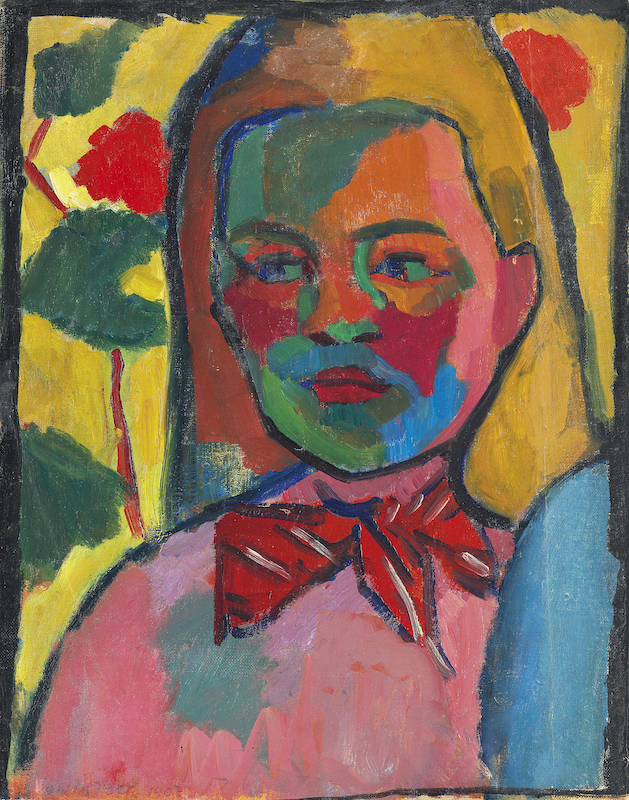
Sonia Delaunay, Young Finnish Girl, 1907 (private collection)

I would have no difficulty walking through rooms of early twentieth century art, but given the range of loans and the effort which had clearly been put into this show, I expected a more exciting selection. A Munch field of cabbages, especially when placed next to The Death Bed's existential bleakness, seems only there to fill up a space. Two full length, full frontal Klimt portraits seems one too many. A small jewel-coloured Kandinsky landscape leaves you desperate for more. Yet Delaunay's Young Finnish Woman is staggering: Fauvist colour with psychological punch. It's only in the last room that things come together again. Picasso's Portrait of Wilhelm Uhde is a fabulously characterful study even without the Cubist experimentation. Together with the solid chunkiness of Woman with Pears, it's a reminder that although Picasso might now be deemed 'problematic', he also seismically shifted the world as we see it. An ever-decreasing naturalism sequence of Mondrians brings things to a satisfying conclusion.  You can leave feeling that you have seen 'the invention of modern art'.

There is an abundance of wonderful artworks in the National Gallery's exhibition, but both the ambition and the achievement are disappointing. Haven't we moved on from a linear 'birth of modernism' narrative? Isn't it time to acknowledge the limitations of a monolithic 'Impressionist era' approach? If you are going to use either of those arguments today, you need to make a much better case than After Impressionism does. 

Saturday, April 15, 2023

'Breaking the Mould' (Walsall New Art Gallery until April 16 2023)

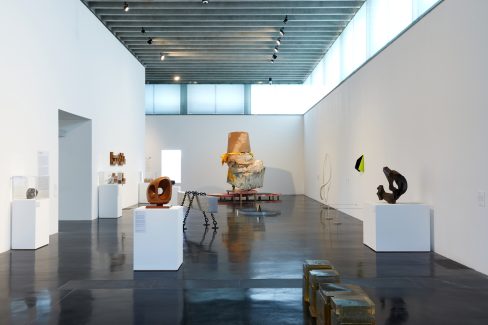
Very belatedly I head to Walsall to see Breaking the Mould: Sculpture by Women Since 1945, an Arts Council exhibition which has been trundling around various galleries for the best part of two years. The New Art Gallery at Walsall, built with millennial optimism, looks and feels precarious. The asymmetric stack clad with terracotta tiles and slashed with horizontal windows seems like a giant Jenga ready to topple. The 'waterfront' square surrounding it is flanked by disused dilapidation and the canal basin features a stagnant dam of plastic bottles. Inside the place is quiet: the art library locked, the roof terrace out of bounds. Its beautifully warm and welcoming wood and very human proportions are crying out for visitors. The experience is blighted by a fear for its future. 

The gallery is blessed with a tremendous permanent collection, far removed from the usual provincial museum diet of  second rate 'old masters' and Victorian taste purchases. The Garman Ryan Collection is an eclectic but careful acquired selection of everything from ancient Roman fragments to Durer woodcuts and a Modigliani; it's displayed thematically in a labyrinth of small rooms you don't mind getting lost in. And at the moment it's enriched by the sub-curation, Here and Queer, subtly distinguished by rainbow labels and accompanied by a well-produced free guide which again makes me worry about expense. There is literally something for everyone here, from moments of unexpected excitement  - John Wishart's Moths on a Blue Path to familiar jolts of pleasure. Epstein's Kitty with Curls alive with earnest youth and intensity contrasts with Freud's Kitty, small and precise like an Early Renaissance profile portrait. A mean and moody Constable study; a Gericault nude, all twisting tension. A Medieval Spanish wooden Christ, arms sorrowfully outstretched; a fragmentary Roman hand. And some of them are sponsored by locals and visitors - my anxiety levels dip slightly with each lovingly personalised label.

These domestic galleries give way to more conventional high-ceiling, white cubes on the third and fourth floors and it's here that Breaking the Mould is on display. Why just women sculptors? All the usual worries about positive discrimination surface. Are visitors expected to see signs of 'woman-ness' in this work? What you actually get is a varied selection of sculpture which includes most of the big names - Hepworth, Barlow, Chadwick, Lucas, Parker - split into three not particularly enlightening themes. Formed, Found, Figured, Are we sticking to 'F' for Female'? On first sight, it is curiously bland. There is nothing very large or very controversial. Phyllida Barlow's huge rough and ready Dunce dominates one room, like an unruly gatecrasher at a cocktail party. 

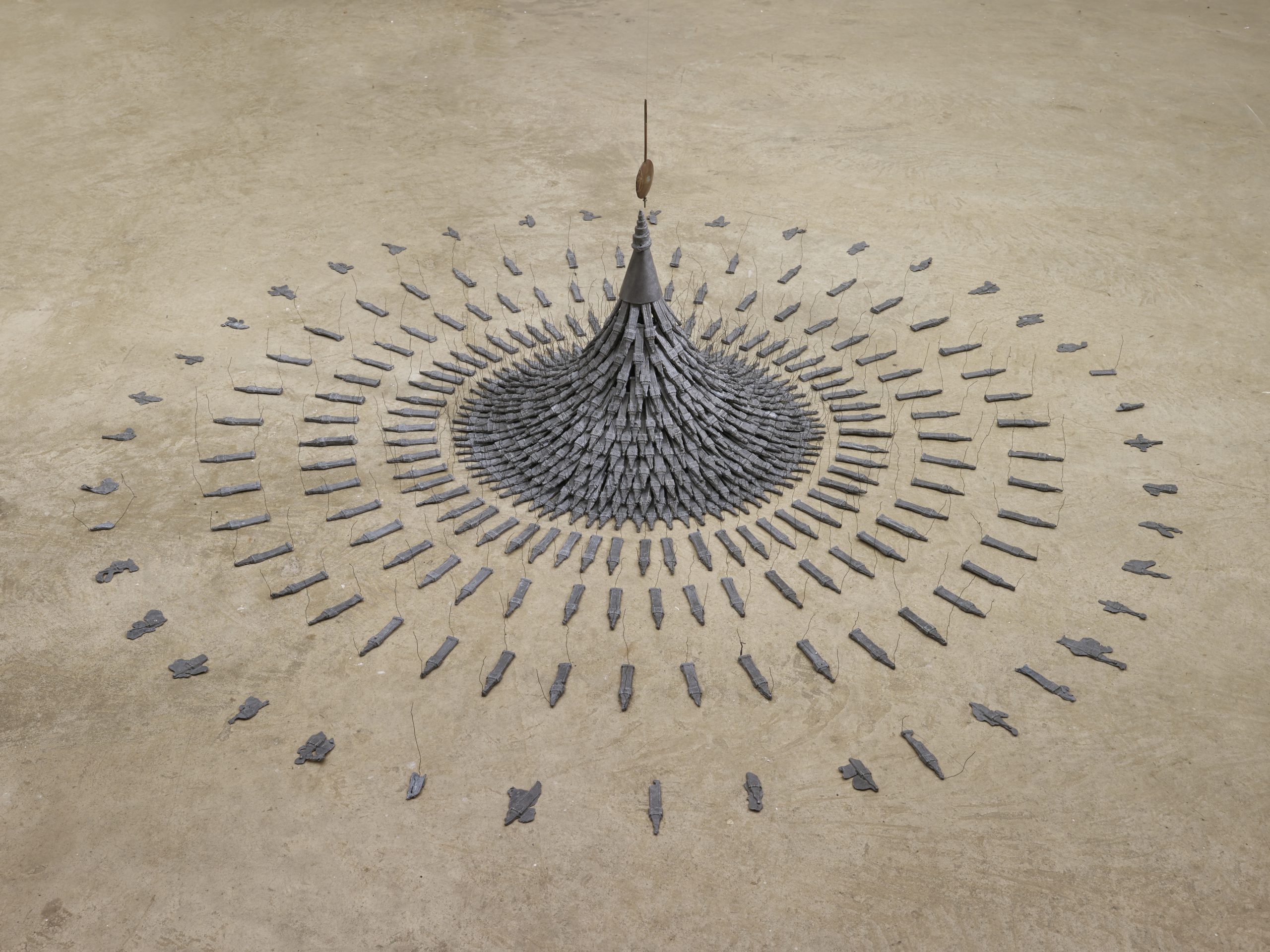
The most effective pieces are the most intriguing: Mona Hatoum's + and - is mesmerisng: mechanically transporting you back to the childhood pleasure of making patterns in the sand with Zen-like repetition and beauty. Sarah Collis and Wendy Taylor can't help but bring a smile with their deceptively simple 'look twice' cleverness. Cornelia Parker's Fleeing Moment seems to defy gravity and time as ever-decreasing Big Bens fan out in a frozen 'splash'. Elsewhere it is the material which triumphs: Hepworth's sleek mahogany and Lucas' stuffed tights beg you to touch. I stare at Rachel Whiteread's Untitled (6 spaces) desperate for it to wobble and wanting to lie on the floor to look into its gelatinous mystery. Jann Haworth Calendula's Cloak, a riot of colour in a space dominated by neutrals, seems a forerunner of Hew Locke's Procession: sinister, celebratory and mythic. 

Cornelia Parker, Fleeting Moment, 1985, Arts Council, © the artist

There is so much variety and so little gender. Even works which reference female experience seem more focused on universal issues. Mary Kelly's Post Partum Document is about language and record as much as it catalogues motherhood. Sokari Douglas Camp's Part of the Audience is less a figurative depiction of women than an counterintuitive exploitation of the possibilities of steel. Yet the very existence of this show creates a self-fulfilling emphasis on gender. Another women's sculpture show has just opened at Hepworth Wakefield, taking the post-war story up to the present day. Just for once, it would be interesting to 'break the mould' and see an exhibition of sculpture that leaves gender out of the equation.

Wednesday, April 5, 2023

'Donatello: Sculpting the Renaissance' (V and A until June 30 2023): Emotional Relief

Lamentation, c.1455-60, V and A

There was always going to be disappointment: a Donatello exhibition without any of the big bangs. No Judith, no bronze David, no St Mark, no Zuccone, no Mary Magdalene. And the V and A does itself no favours by having the biggest bang they've got as the first thing you see. The marble David, Donatello's first major commission, often feels like the boring, fully clothed brother of that famous saucy nude, but here its clean beauty has space to breathe. The deep veining of the marble pulses like veins on the skin, the human details of puckered cloth creates intimacy, the over-long neck and small head make him impossibly young and yet undeniably noble. And the curators have an extra trick, a cut-through arch to the end of the show and an almost but not quite mirror-image of the David, time- and restoration-ravaged. You don't fully appreciate the cleverness until the end.

It is the staging of the exhibition which really elevates it. The open space of the Sainsbury Gallery retains an airiness, with long vistas across to the big pieces and shadowy alcoves for the drawings; the deep, calm aquamarine is a perfect foil to marble, bronze and gold; the lines are clean, the captioning just short of twee (there were a few too many 'charmings' for my taste). And the lighting is superb: the poignancy of the shadow cast by the tattered drapery on the bronze crucifixion catches in your throat. There is so much to admire that it seems churlish to dwell on the absences. There is a genuine, but not entirely successful, attempt to explain the processes: the curators seem overly concerned with Donatello's training as a goldsmith, and his skill as a draughtsman - tricky to illustrate when neither gold-work nor drawings survive. There is little sense of his career and stylistic development. Too little attention is paid to his skill as a stone carver, or his technical development of bronze casting, and his exploitation of wood is absent. Instead we get a lot of terracotta; a lot of 'after', 'studio of' and 'attributed to'. Sometimes it feels as if he is being reduced to a producer of putti and churned out Virgin and Childs.

Pazzi Madonna, c.1420, Staatliche Museen, Berlin

I'm being picky. What you do get is some of the most beautiful, affecting and virtuosic sculpture that was ever made. The Pazzi Madonna, so softly carved out of crisp marble, literally brought tears to my eyes. The noses of mother and child almost desperately press against each other, separated by a shadow which seems like a wound; Christ's tiny clutching hand and almost laughing open mouth, contrast with the downcast sorrow of her premonition. The Miracle of the Mule (c.1446-50), usually half unnoticed in the Basilica of S. Antonio in Padua, is so complex, so clever, that you can look at it for hours. Donatello's ability to work in ultra-shallow riliveo schiacciato is easy to take for granted: mathematical perspective, straightforward to accomplish with drawn orthogonals on paper, is skewed by even the most shallow relief. Here Donatello juggles perspective, multiple figures, emotional range and a complex triple-arch composition which you can see caught Mantegna's eye. The whole surface is alive with texture, light and reflection. For me, though, the absolute highlight is the late Lamentation, a rough hewn slab of raw emotion. Mary's haggard grief is reminiscent of the wooden Penitent Magdalene. Snaking drapery, hair and limbs create an inverted bacchanale of despair that dissolves time - quattrocento could be the early twentieth century.

The exhibition ends with a slightly pointless section on 'Donatello's legacy' which allows the V and A to show their 19th century copy of the bronze David (1440), but surprisingly not their Judith and Holofernes (c.1455). It emphasises the show's weakness at presenting the big picture: those two copies summarise his range, and his real legacy can be seen, not in trite tributes, but in Rodin, in Kollwitz. You leave with a very good sense of Donatello's relationship with Michelozzo; of the studio system which operated in the early Renaissance; of the importance of Padua as an artistic centre. But you have very little sense of Donatello as a man (which could be deliberate); of his ability to create emotional and psychological insight; of his versatility, or indeed of his artistic influence. In this sense it's an exhibition for the enthusiast and the scholar, rather than the general public, which seems a great shame.

Saturday, April 1, 2023

Berthe Morisot: Freedom in Restriction

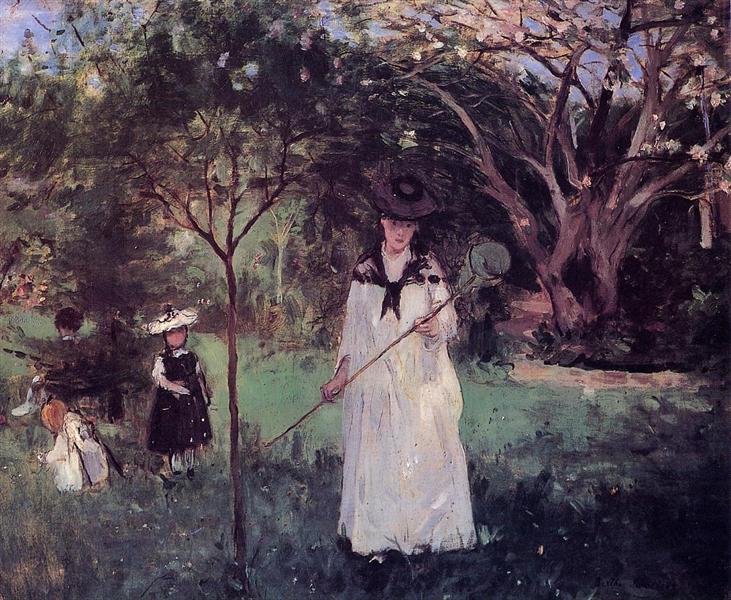
Berthe Morisot, The Butterfly Hunt, 1874, Musee d'Orsay

For a long term it felt like Berthe Morisot (1841-1895) was The Woman Artist. In the early 1970s, when New Art History was gaining ground her role as an Impressionist, but one who also represented the social restrictions of nineteenth century women was much written about. The ubiquitous popularity of Impressionism has receded, and the boom area for feminist art history now is arguably the Baroque, with Artemisia Gentileschi leading the way, closely followed by artists like Lavinia Fontana. Morisot seems marooned in a backwater, neither a big enough name, nor enough of a novelty to garner interest. Her resolutely female domestic subject matter nowadays seems tame, almost like a flag of surrender in comparison with those seventeenth century women who so obviously colonised male artists' territory. An upcoming exhibition at Dulwich Picture Gallery (starting 31 March 2023), whilst a welcome and long overdue examination of Morisot's work, is positioning her in the context of eighteenth-century French painting and thus seems at risk of reinforcing ideas of a feminine aesthetic in her work.

Morisot, as she is presented nowadays, had it pretty easy. She came from a wealthy enough background to indulge her enthusiasm for painting with private tutors and chaperoned visits to the Louvre. She chose a husband who allowed her to continue to paint, in comparison with her sister who gave up her art to become the wife and mother society expected. Morisot's husband, Edouard Manet's brother, Eugene, is often presented as a shadowy figure persuaded into a marriage of convenience which allowed the two artists to remain close. She had only one child and so never became overwhelmed with domestic duties in the way other would-be women artists of the time were. She could afford to produce uncommercial work, and at her death over 80% of her paintings remained in the family's possession. We like our artists to struggle and somehow all these advantages seem to be held against her and her images of seemingly contented domesticity and bourgeois virtue.

The irony is that Morisot, in terms of her drive and activity within the Impressionist circle, was nothing like the little bourgeois woman sitting at home which her paintings seem determined to portray.  She withstood considerable family pressure to give up her painting, finally agreeing to marry at the age of thirty-two, long after she was considered an old maid. She made a conscious decision to exhibit in what would become known at the first Impressionist exhibition in 1874, despite having previous Salon success and against the advice of Manet: she was savvy enough to see the benefits of a show which enabled her to show nine varied canvases in a less crowded and competitive environment. She similarly auctioned her work at the 1875 Hotel Drouet sale, achieving the highest price of the day. At the second Impressionist exhibition she showed more works than anyone else, and she participated in all but one of the rest, missing only the one after the birth of her daughter. Her final letter expressed hope for a future museum dedicated to Impressionism. It is a damning testament to the continued sexism of the art world, that Morisot, so deeply embedded into the Paris Impressionist circle, is not only still treated as an also-ran, but that this second-class status goes largely unchallenged.

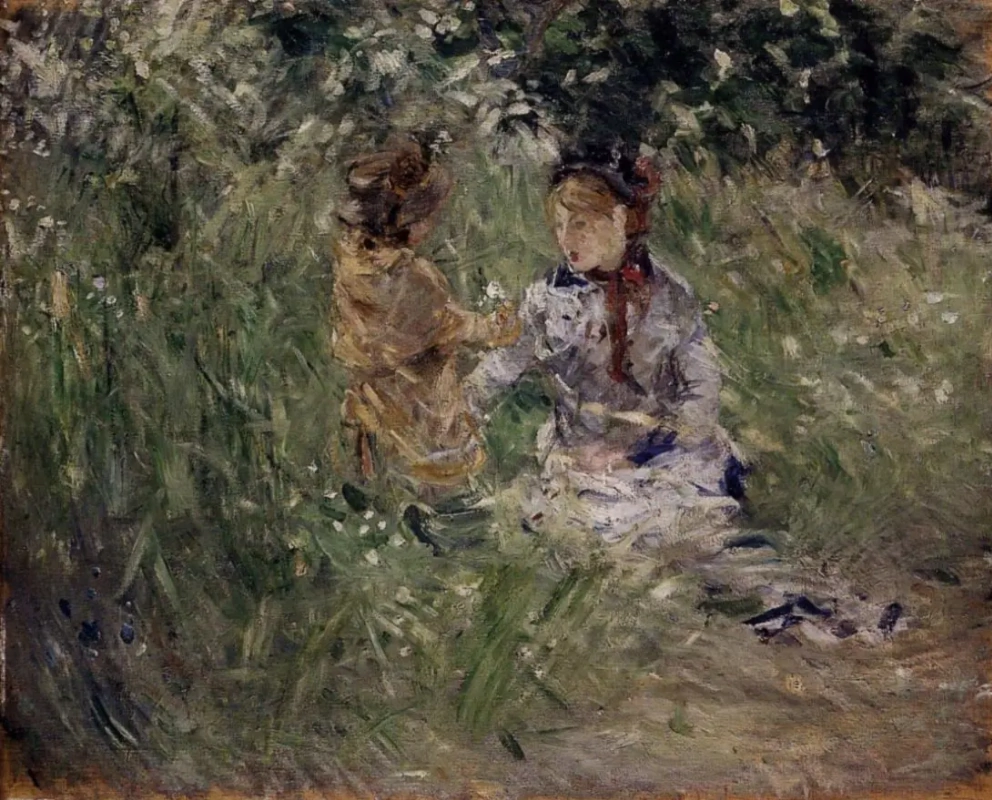
Berthe Morisot, Woman and Child in a Meadow at Bougival, 1882, 
National Museum of Wales

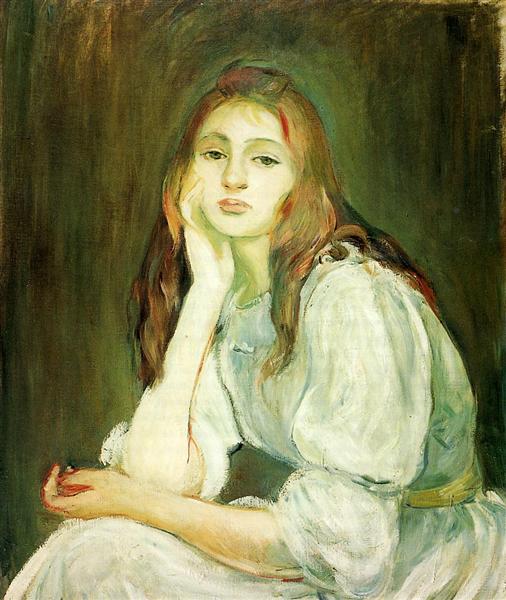
The Impressionist movement was frequently described as feminine by contemporary critics. The unfinished nature of the work, the emphasis on transience and changeability, the importance of colour were all seen as womanly. Morisot herself was criticised for not having the masculine stamina to finish her canvases. Today we might not recognise such gendered criticism, but the perceived prettiness of much Impressionist art and brushwork which might be described as feathery, light or even fluffy continues that feminine discourse. Yet in terms of technique, Morisot is resolutely a-feminine, anti-pretty: she frequently applied paint in rapid, dashed strokes creating a sense of hurriedness, certainly, but also suggesting vigour, dynamism, sometimes even annoyance. Her colour is less pastel prettiness than cool and clear, influenced by her time as a pupil of Corot but also following a range exploited by other French naturalists of the time. Like Manet, she retained a fondness for black using it sparingly but effectively for emphasis. Her work shows such a steady development away from 'finish' that in canvases like Woman and Child in a Meadow at Bougival the figures dissolve into a semi-abstract storm of brushmarks. Only in the last years of her life did her palette warm, her interest in line return and her brushwork soften, to create works with an affinity to Auguste Renoir. Her portrait of her daughter, Julie Daydreaming, is reminiscent of Edvard Munch in its sinuous line, plain background and colour blocks creating an enigmatic mood: symbolic white, loose hair and the hint of something red in the teenager's hand.

Berthe Morisot, Julie Daydreaming, 1894, (Wikipedia Commons)

Morisot's subject matter, with its focus on the routine and restriction of bourgeois domesticity, is often taken as another marker of femininity. Yet, whereas her contemporary, Mary Cassatt, seems consciously determined to catalogue women's lives, becoming a female 'painter of modern life', Morisot seems almost oblivious to her subjects, their faces erased, the bodies lost in the haze of brushwork. Cassatt painted female subjects at the theatre, captured as if by accident in the public gaze; Morisot's At the Ball features a dressed up, posed woman apparently sitting at home.  She painted what was to hand for her own convenience, thereby avoiding the difficulties and awkwardness she described when trying to paint plein air in public. And although her closeness to those subjects - her sister, her husband, her daughter - shows through, the emotion is almost accidental. There are psychological readings of entrapment and erasure; some have focused on her supposed empathy for servants; another argument suggests that she was deliberately choosing her battles - innocuous subjects to balance her radical technical choices. All this slightly missing the point. What she is really interested in is the act of painting itself, the transmission of transience onto canvas. 

Berthe Morisot is a classic example of the institutional sexism which still haunts the art world. Her subjects are seen as evidence of the restrictions under which she lived her life, as a middle class woman in the late nineteenth century, and by implication her art is belittled by those restrictions. Her gender means that she is seen as a woman first and an artist second, so subject matter and biography always seem to take precedent over the technique, and her truly radical use of paint is never fully explored. Appreciated and applauded at the time, interest in her work very quickly dwindled after her death. Surely it's time to move beyond Morisot the 'woman Impressionist' (to quote the title of the 2018 Barnes Foundation exhibition) and see her as an integral and innovative member of the movement. 

Wednesday, March 29, 2023

'Gainsborough and the Legacy of Landscape' at Gainsborough's House (Until June 11 2023): Money Well Spent?

Gainsborough's House in Sudbury, Suffolk, reopened in November 2022 after a £10.5m renovation and extension. You can literally smell the money: the foyer still has that unique tang of newness. You can certainly see it: the new extension is elegantly engineered into an awkward site; the façade employs the locally characteristic combination of brick and flint; the interior doors are so weighty you can barely open them; and their collection of Gainsboroughs are hung on a background of glorious green silk. And ultimately you pay for it: the entry fee, including temporary exhibitions is nearly £16.

Landscape with Woodcutter and Milkmaid(1755), Woburn Abbey

The extension allows for two temporary exhibition spaces, the larger currently occupied by Gainsborough and the Legacy of Landscape: Masterpieces from Woburn AbbeyIt is in all honesty a slightly disappointing show. The first section gives prominence to Gainsborough's commissions for the Duke of Bedford, a welcome reminder that the artist who is usually seen as a portraitist who wished he was a landscapist, was actually recognised as a painter of nature from early in his career. Landscape with Woodcutter and Milkmaid (1755), is a show-stopper in itself, in terms of scale (1m x 1.2m), execution and its intriguing narrative. The soft pinkish clouds give a rococo warmth to the artist's usual earthy, and sometimes dingy, palette. The composition is a ramshackle picturesque, Gainsborough's loose brushwork creating a countryside of exaggerated disorder, rutted lanes and knarled bark which mirrors the fluster of the milkmaid with her undone stays and her slipping shoe. The grouping of the figures and cow is almost Hogarthian in its style and innuendo and the slither of white milk just visible in the pail is a final masterful flourish. 

The Dutch examples - and there are some fine works, notably Albert Cuyp's Artist Sketching Near Elten (1655)  - clearly show both their influence on Gainsborough and on British art in general. However, the second part of the display, 'the legacy', is far less convincing. The wall text describes the family selling Dutch works in order to purchase contemporary British examples, but they might have been advised not to. The artist who most obviously picked up the baton from Gainsborough, John Constable, is overlooked in favour of Frederick Richard Lee and Augustus Wall Callcott both of whom seem stiff and contrived compared with what has gone before. Edwin Landseer, superb painter of animals though he was, seems much less interested in the generic rolling countryside behind the Deer in Coldbath Fields (1835). Instead we make the significant leap to Richard Parkes Bonington whose French influence takes art in a different direction. I can't fault the gallery space or the labelling but the exhibition fails to do real justice to its title.

What Gainsborough's House does boast is a wonderful collection of the artist's own works, some exhibited in a sensuously rich cocoon of dark wood and deep green silk, some in the intimacy of living spaces in the original house. The new gallery works well, sympathetic to Gainsborough's landscapes and making the portraits sing. One of my favourites of his early style, Peter Darnell Muilman, Charles Crokatt and William Keable in a Landscape (1750), has never looked better with the reds and whites emphasised and the youthful, bulbous nosed faces more expressive than I remember. Yet information is reduced to tombstone facts on large tatty cards strewn on a bench: they claim to be temporary but four months after opening, and given the opulence of the surroundings, they need to do better. Their own collection is boosted by loans, at present including the National Portrait Gallery's David Garrick (1770) who sparkles with urbane charm, and two head and shoulder images of his daughters, every brushstroke applied with paternal love and pride.

I wanted to enjoy Gainsborough's House but it was a frustrating experience. It seems so much less than the sum of its parts. Cedric Morris' display is crammed into a room in the old house. The silk exhibition, potentially very interesting, seems an underdeveloped afterthought. Who is going to benefit from the multi-million pound investment? I hope, though I'm not convinced, that it will encourage visitors into the town. If I lived locally I might resent the fact that this beautiful building and the art inside it was hidden behind such a significant paywall. Certainly, on the mid-week day I visited it was quiet, and it is difficult not to compare the experience unfavourably with a trip to Christchurch Mansion in nearby Ipswich, free and with an exhibition space attached, this was a bustle of engaged visitors.


'Landscape Rebels' (until April 16 2023): Passionate but not Preachy

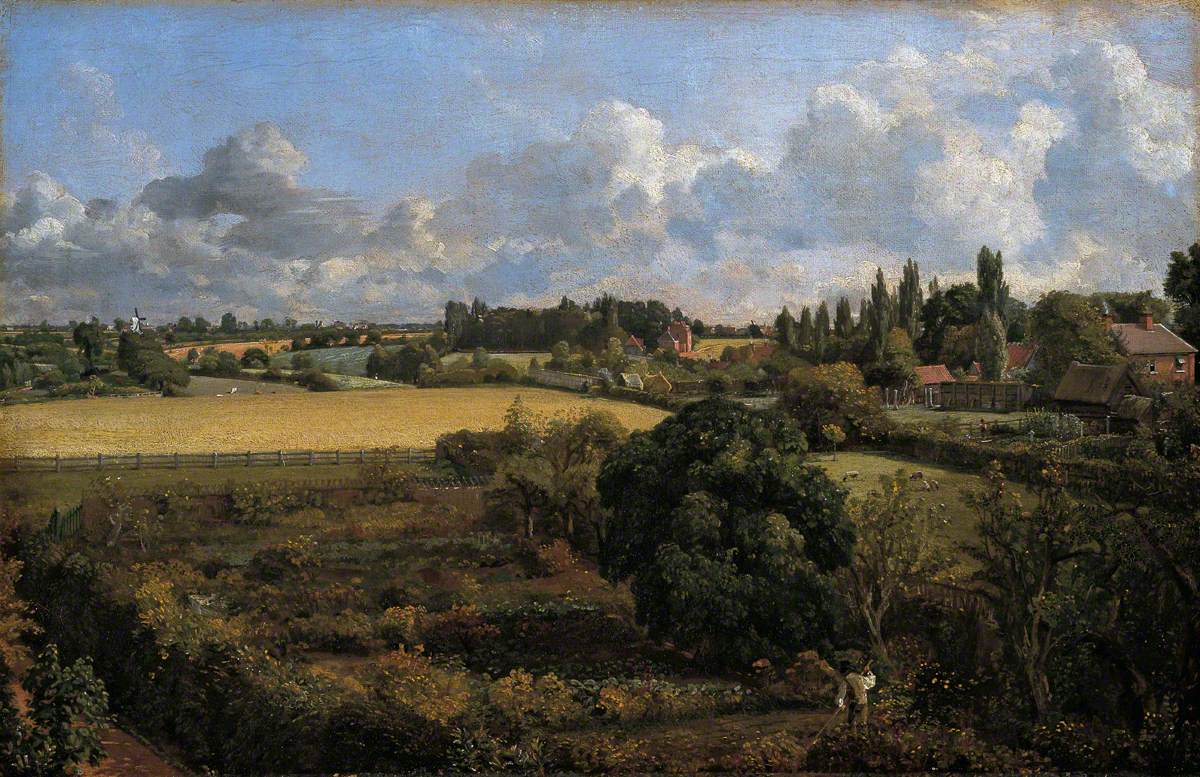
 John Constable, Golding Constable's Kitchen Garden, (1815), Ipswich Borough Council Collection

Christchurch Mansion, in Ipswich, is an absolute treasure, one of those traditional, local museums which attempts, and largely succeeds, in giving an accessible, potted cultural history - furnished rooms, children's toys, Victorian kitchens. It's all slightly down at heel, but so warmly staffed and so obviously well-intentioned, that you forgive the deficiencies. Given the recent decimation of local amenity and arts funding it's a miracle it's open at all. 

The house itself is a stylish Tudor red brick, the roofline enlivened by a series of Dutch gables, the entrance aggrandised by columns and topped with a stunning octagonal clock face. It seems overloaded with windows, everything slightly off kilter. Once inside the entrance hall is impressive: double height, galleried, with a black and white tiled floor straight out of Vermeer and the usual array of family portraits joined by random copies of Renaissance sculpture. So far so predictable, but the house has some surprises up its sleeve. The Wingfield Room features spectacular oak panelling, not original but moved from a house in the centre of the town: the sixteenth century overmantel is quirkily and audaciously carved with nude figures of the Judgement of Paris and the Three Graces. The Upper Chamber, sagging under the weight of oak, contains sections of preserved plaster painting from several Ipswich houses. But the real treat, is the art collection: the house boasts some wonderful works by local artists, Thomas Gainsborough and John Constable.

At present some of the best of these are on show as part of Landscape Rebels in the Wolsey Art Gallery, a purpose-built exhibition space within the mansion. Hats off to the curators. This is a cleverly put together show, with something for everyone and a clear but never overly didactic determination to make you think about the climate crisis. There are 1960s floral print dresses, Victorian pinned moth collections, a lethal-looking shark-tooth spear and a range of artworks from seventeenth Dutch landscapes to contemporary commissions. You can go round and simply enjoy the objects or you can read the carefully written wall texts and think about coastal erosion, forest fires and industrial pollution.

If you were being picky, you might argue that Golding Constable's Kitchen Garden (1815)one of a pair of uncharacteristically precise paintings of his family home which Constable painted for himself and in memory of his parents, is not particularly rebellious, nor especially related to the climate crisis. The same could be said of Cedric Morris, another local lad, or indeed Walton Bridges (1806), one of those early Turner’s that harks back rather than looks forward. Equally, you could argue that the whole concept was a poor man’s version of last year’s Radical Landscapes at Tate Liverpool. But do I really care? This was a perfect balance of revisiting old friends - Philip Wilson Steer’s Knucklebones, Walberswick (1888-9) with its family beach holiday nostalgia of languor and awkwardness - and making new ones - Mary Warsop's Coastal Suffolk (1981) grey-green stack of landscapes in which sky and sea become interchangeable; or Guy William Eves' precise yet evocative 'tree portraits' (2020). And it gave you something to think about. In one room, with limited resources but real thought and care, the curators have put on a great exhibition. Given the wall of comments left at the end and the numbers I saw visiting, it's one which has clearly resonated with the public. I overheard people saying this was their third visit, and of course an added bonus is that it is a free show. Ipswich is a lucky town.


Thursday, March 23, 2023

Islanders: A Dreamily Beautitful Show (Fitzwilliam Museum until June 4 2023)

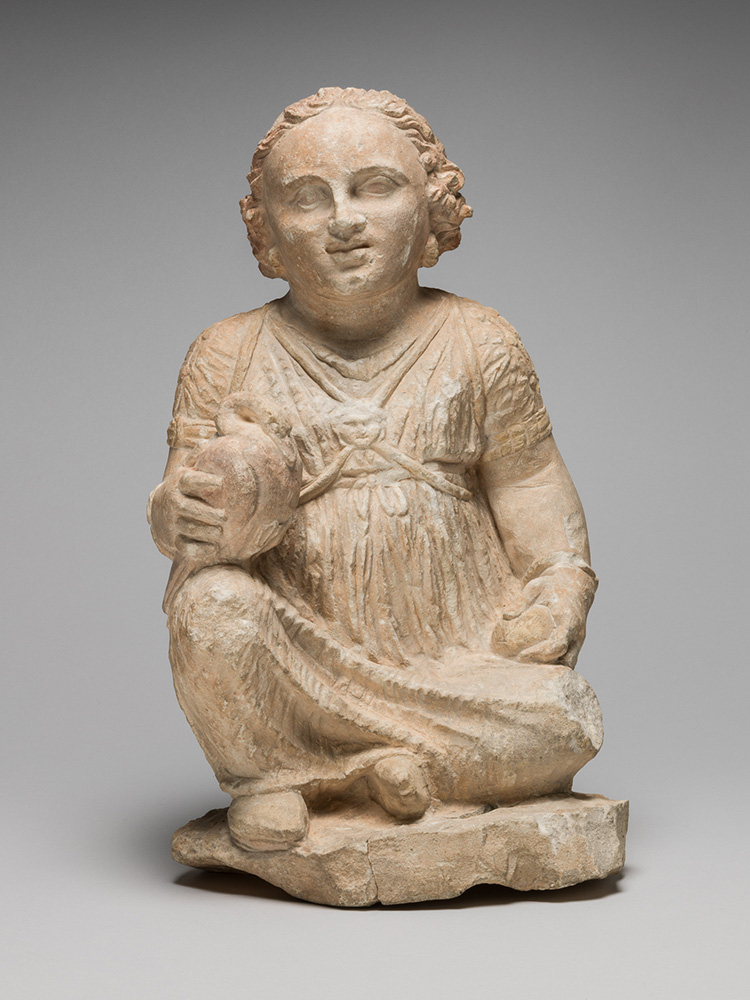
Hellenistic statuette of a seated child holding dove (c.200BC) (© Fitzwilliam Museum)

Islanders: The Making of the Mediterranean, 
currently showing at the Fitzwilliam Museum in Cambridge, is one of the most beautifully curated exhibitions you're likely to see this year. You are ushered in to the sounds the sea, calmed by a palette of blue, white and terracotta. Gauze softens the edges of the room as you meander around oval island displays. The blown-up images of Greece, like holiday brochures on the walls, are intrusively unnecessary because you have already been transported to the Mediterranean. But this is also an exhibition full of detailed scholarship, the end product of a four year research project which starts with a complex timeline of the three islands featured - Crete, Cyprus and Sardinia - and ends by challenging you with the question of what it means to be an islander in Britain today.

This duality - aesthetic versus intellectual - is a problem which the exhibition never really reconciles. The overall premise - that these are disparate yet connected communities - is slippery enough to grasp and the broadly thematic structure means it is increasingly difficult to keep hold of the complex shifts of time and space. I went round the exhibition twice, the first time carefully reading the informative but often annoyingly placed labels, getting steadily more and more frustrated by my own inability to keep all the mental plates spinning. 

Second time round, I was happy to drift; to enjoy the wonders. And there are wonders aplenty.  Figurines old beyond time which, with their clean lines and formal simplification would pass as twentieth century modernism in miniature. Elegantly carved faces which seem more East Asian than Mediterranean. A lion's head earring, so tiny and so beautifully worked that you literally press your nose to the glass of the display, entranced by the gleaming gold. Reassuringly familiar hints of Egypt, Assyria, Classical Greece. Cretan Kamares pottery with rich coloured geometry which directly resonates with the other exhibition on in Cambridge at the moment: Lucy Rie at Kettle's Yard.  Mundane practicality - copper ingots, ox-hide shaped for ease of carrying and stacking - alongside primitive mystery - an ancient Sardinia warrior figure with four eyes, four arms and two shields.

A treasure trove. And it's free. You can pay over £15 to see Labyrinth at the Ashmolean. I haven't seen this and I'm not judging. But if you have a wander round the rest of the Fitzwilliam, you can't help feeling it could do with a little TLC: some new wall coverings, some revamped displays. The museum lost out in the last round of Arts Council funding, despite the fact that the place was packed mid-week in March, despite the fact that they consistently put on fantastic, innovative exhibitions like Islanders. So go if you can, make a donation if you are able, enjoy the love, care and scholarship that has gone into it and lose yourself among the beauty of the islands.

Zurbaran (National Gallery until August 23 2026): Perfection in a Piece of Cloth

Francisco de Zurbaran, The Martydom of St Serapion , 1628, Wadsworth Atheneum, Hartford Connecticut Francisco de Zurbaran is often describe...